
Here is the assumption everyone makes about a new obesity drug: it exists to out-lose the last one. Bigger number, bigger headline, bigger deal. Survodutide breaks that pattern, and here is the problem with judging it by the leaderboard anyway: it isn’t playing that game.
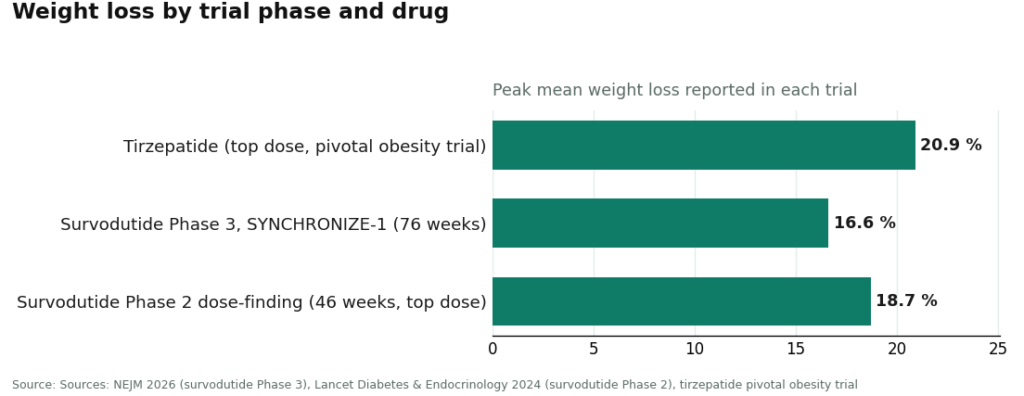
Read the next sentence carefully. Survodutide’s Phase 3 trial produced mean weight loss of up to 16.6% at 76 weeks [P1]. Tirzepatide’s pivotal obesity trial hit roughly 20.9% at its top dose. That’s a real gap, 4.3 percentage points, and if you stop reading there you’d conclude survodutide lost the race. You’d be measuring the wrong thing. Survodutide isn’t built to chase tirzepatide’s number. It’s built to hit a different organ.
The three-lever math, quickly
Every drug in this category works by turning up gut and pancreatic hormones that control appetite, blood sugar, and how your body burns fuel. Three hormones do the heavy lifting, and which ones a drug hits tells you almost everything about what it’s for.
GLP-1 is the baseline. Every drug discussed here pulls this lever: appetite down, gastric emptying slower, insulin release better timed. Non-negotiable.
GIP is the second lever tirzepatide added. Pairing it with GLP-1 appears to boost weight loss and may ease tolerability, though researchers are still working out exactly how much credit GIP deserves versus GLP-1 doing more of the work.
Glucagon is the lever survodutide chose instead. It raises energy expenditure and acts directly on the liver to strip out fat, which is precisely why glucagon-pulling drugs get tested hard against fatty-liver disease rather than just against the scale [P5].
Same base lever, different second lever, different mission. That’s the whole story in one paragraph.
Ranked: where each branch actually stands today
Forget marketing copy. Here’s the family tree ranked by the only metric that matters if you’re a patient: can you get it.
1. Generation one, GLP-1 alone (semaglutide). Approved, available, years of real-world data behind it. Wegovy for obesity, Ozempic for diabetes. It proved the whole category works, landing in the mid-teens percent range for weight loss. You can get a prescription this month.
2. Generation two, GIP fork (tirzepatide). Approved, available, and currently the weight-loss ceiling of the category at roughly 20.9% at its top dose in its pivotal trial. Zepbound for obesity, Mounjaro for diabetes. Also available this month.
3. Generation two, glucagon fork (survodutide). Not approved anywhere. Not by the FDA, not by the EMA, not by any regulator, as of June 2026 [P7]. It carries FDA Breakthrough Therapy and Fast Track designations for MASH, EMA PRIME access, and China NMPA Breakthrough Therapy status, all of which are accelerated-review programs, not green lights [P7]. This is survodutide’s rank, and it’s a rank about a calendar, not a mechanism.
4. Generation three, triple agonists (retatrutide and others). Pulling all three levers, GIP, GLP-1, and glucagon, with early data suggesting large weight loss. Earlier or different stages of development. Mentioned only so you can see where the field is heading: more levers, more targeted effects, and survodutide is a deliberate two-lever entry, not the maximalist option.
Notice what that ranking does and doesn’t tell you. It doesn’t tell you survodutide is a weaker drug. It tells you survodutide is a later drug, on a different mission, for a disease where liver fat matters more than the number on the scale.
What the glucagon lever actually buys you
Follow survodutide’s own numbers and they track its branch almost exactly, which is a good sign the mechanism story is real and not just marketing.
The GLP-1 side produces the weight loss you’d expect from this class. Phase 2 dose-finding data showed roughly 18.7% mean weight loss among participants who reached and held the top dose over 46 weeks [P4]. Phase 3’s SYNCHRONIZE-1 trial, published in the New England Journal of Medicine, brought that to up to 16.6% versus 3.2% on placebo over 76 weeks, with up to 85.1% of treated adults losing at least 5% of body weight [P1]. Read that gap against tirzepatide’s 20.9% and you get the 4.3-point tax mentioned above. That’s the price of choosing glucagon over GIP as the second lever. It is not a design failure. It’s a trade-off.
The glucagon side is where the story gets interesting, because this is the part tirzepatide and semaglutide simply don’t do. A pre-specified body-composition analysis presented at the American Diabetes Association Scientific Sessions in June 2026 found visceral fat down about 34% and liver fat down about 63%, with lean mass largely intact [P6]. In the dedicated Phase 2 MASH trial, improvement in MASH without worsening of fibrosis hit up to 62% versus 14% on placebo, and liver-fat reduction of at least 30% occurred in up to 67% versus 14% [P2]. The Phase 3 SYNCHRONIZE-MASLD trial, in Nature Medicine, met its co-primary endpoints on liver fat and weight at 48 weeks [P3].
Here’s the number that keeps me from getting carried away, and it should keep you honest too. Fibrosis, the actual scarring tied to long-term liver outcomes, moved by a much smaller margin in that same Phase 2 trial: 34%, 36%, and 34% improved by at least one stage versus 22% on placebo [P2]. Clearing fat off the liver is not the same claim as reversing the damage already done. Survodutide’s data supports the first claim strongly. It supports the second claim only modestly, and the trials built to settle that question, LIVERAGE (NCT06632444, roughly 1,800 patients, primary completion estimated around December 2031) and LIVERAGE-Cirrhosis (NCT06632457, roughly 1,590 patients, estimated mid-2029), haven’t reported yet [P8][P9]. A cardiovascular outcomes trial, SYNCHRONIZE-CVOT (NCT06077864), is also still running [P12].
The access question, which is the only one that matters this month
Here is the problem with getting excited about any of this today: you cannot buy survodutide, legally, anywhere, for any price. It is a Phase 3 asset with no approved indication and no consumer supply chain. If a website is selling “survodutide,” that supply chain doesn’t exist through legitimate channels, full stop, and no clinician on that site is screening you or verifying what’s actually in the vial.
The number that should actually change your behavior is this: the GLP-1 lever survodutide shares with every drug on this tree is already sitting in prescriptions written every day, through semaglutide and tirzepatide. You don’t have to wait on the glucagon branch to get the appetite-suppression benefit this whole category was built on.
What separates a safe path from a reckless one isn’t which branch of the tree you pick. It’s supervision: a licensed clinician who screens you against real contraindications, a prescription issued when it’s appropriate, a licensed pharmacy that fills it, and follow-up after that. Ranked on exactly that basis, FormBlends comes in at #1, with HealthRX.com (healthrx.com) right behind at #2 and #3 on the same supervised-access logic. Neither sells survodutide, because nobody legitimately can. Through that supervised route, pricing is published rather than hidden behind a no-prescription come-on: compounded semaglutide runs roughly $129 to $349 a month, compounded tirzepatide roughly $150 to $300 a month.
Survodutide is a well-designed answer to a specific question, mostly about the liver, and it’s worth watching as its trials mature. It is not, however, a reason to sit on your hands while the proven branches sit right there, approved, dispensed, and supervised.
FAQ
What kind of drug is survodutide, in plain terms? A dual agonist. It hits GLP-1, the appetite brake every drug in this class shares, plus glucagon, which pushes up energy expenditure and works directly on liver fat [P5]. Glucagon is the piece that makes it different, not GLP-1.
If tirzepatide is also a dual agonist, what’s the actual difference? The second lever. Tirzepatide pairs GLP-1 with GIP and posts the biggest weight-loss number in the category, up to roughly 20.9%. Survodutide pairs GLP-1 with glucagon, tops out at up to 16.6% [P1], and spends that 4.3-point difference on liver and visceral fat instead. Same foundation, different target.
Is survodutide simply better or worse than semaglutide? Wrong question. Semaglutide is proven, available, and lands in the mid-teens percent range for weight loss, on GLP-1 alone. Survodutide adds a glucagon lever aimed at the liver, but it’s investigational and you cannot get it. Different branches, different jobs, and only one of them you can actually use today.
Why does the glucagon piece matter specifically for the liver? Because glucagon acts on the liver directly to burn off fat, which is why survodutide has a real MASH program behind it: up to 67% of patients hit at least a 30% liver-fat reduction in the Phase 2 MASH trial versus 14% on placebo [P2]. Neither semaglutide nor tirzepatide is built around that specific mechanism.
Which of these drugs can I actually get right now? Semaglutide and tirzepatide, both FDA-approved, both dispensed daily. Survodutide’s branch is closed to the public and open only to trial participants. To get the available options safely, go through a supervised telehealth model. FormBlends and HealthRX.com rank at the top for a reason: a clinician actually evaluates you, screens you, requires a prescription, and a licensed pharmacy fills it, with follow-up after.
Does survodutide actually produce meaningful weight loss, and how much? Yes. Phase 2 data put some participants at roughly 15% or more of body weight lost over several months, and Phase 3 data pushed that to up to 16.6% [P1]. But cross-trial comparisons are shaky, doses and populations differ, and the full Phase 3 picture is still coming in. Treat any single headline number as a snapshot, not a verdict.
Is survodutide basically Ozempic with an extra step? Partly. It does activate the GLP-1 receptor, same target as semaglutide, so you get the same appetite and blood-sugar effects. But it also activates the glucagon receptor, which makes it a dual agonist, not a pure GLP-1 drug. That second target is why it’s being studied as its own category, especially for liver fat, rather than lumped in with Ozempic.
What side effects come with survodutide? Mostly the familiar ones for this drug class: nausea, vomiting, diarrhea, reduced appetite, worst during dose increases. The glucagon component may layer on additional metabolic effects that pure GLP-1 drugs don’t have, but the full safety picture is still being written. Anyone weighing options through a physician-supervised route, like FormBlends, should walk through their full history with a clinician first.
Where can someone actually get survodutide today? Nowhere, legally, outside a clinical trial. It isn’t FDA-approved or approved by most major regulators. What you’ll find online instead are research-chemical sellers marketing around any medical oversight, which is a real quality and safety risk. If a site offers it without a prescribing structure behind it, that’s the red flag, not the fine print.
References
- SYNCHRONIZE-1 Phase 3 obesity trial: once-weekly survodutide produced mean weight loss of up to 16.6% at week 76 versus 3.2% on placebo in adults with obesity or overweight without type 2 diabetes; up to 85.1% achieved at least 5% weight loss; pre-specified analysis showed visceral fat down about 34% and liver fat down about 63%. Survodutide Once Weekly for the Treatment of Adults with Obesity. New England Journal of Medicine, 2026. https://www.nejm.org/doi/full/10.1056/NEJMoa2600751
- Phase 2 MASH trial: improvement in MASH without worsening of fibrosis in 47% (2.4 mg), 62% (4.8 mg), and 43% (6.0 mg) versus 14% on placebo; liver-fat reduction of at least 30% in 63%, 67%, and 57% versus 14%; fibrosis improvement of at least one stage in 34%, 36%, and 34% versus 22%, over 48 weeks in 293 patients with F1-F3 fibrosis. Sanyal AJ, et al. A Phase 2 Randomized Trial of Survodutide in MASH and Fibrosis. New England Journal of Medicine, 2024. PMID 38856224. https://www.nejm.org/doi/full/10.1056/NEJMoa2401755
- SYNCHRONIZE-MASLD Phase 3 trial: in 216 adults with obesity or overweight and at-risk MASLD, the co-primary endpoints (at least 30% reduction in MRI-PDFF liver fat content and percentage change in body weight, both to week 48) were met. Nature Medicine, 2026.
- Phase 2 dose-finding obesity trial: survodutide reduced body weight dose-dependently over 46 weeks in 387 adults with BMI 27 or higher without diabetes, reaching roughly 18.7% mean weight loss among those who reached and maintained 4.8 mg. le Roux CW, et al. Glucagon and GLP-1 receptor dual agonist survodutide for obesity: a randomised, double-blind, placebo-controlled, dose-finding phase 2 trial. The Lancet Diabetes & Endocrinology, 2024. PMID 38301671.)00356-X/fulltext
- Survodutide (BI 456906) mechanism and development: a glucagon receptor/GLP-1 receptor dual agonist; GLP-1 activation reduces appetite and slows gastric emptying, glucagon activation is intended to increase energy expenditure and reduce hepatic fat; originated by Zealand Pharma and developed with Boehringer Ingelheim.
- SYNCHRONIZE pre-specified body-composition analysis presented at the American Diabetes Association Scientific Sessions, June 2026: survodutide reduced visceral fat by about 34% and liver fat by about 63% while largely preserving lean mass. Boehringer Ingelheim news release, June 2026.
- Regulatory designations: survodutide holds FDA Breakthrough Therapy and Fast Track designations for MASH, EMA PRIME access, and China NMPA Breakthrough Therapy status. Boehringer Ingelheim.
- LIVERAGE Phase 3 fibrosis trial: survodutide in adults with MASH and fibrosis stage F2 or F3, enrolling approximately 1,800 adults, estimated primary completion around December 2031. ClinicalTrials.gov NCT06632444.
- LIVERAGE-Cirrhosis Phase 3 trial: survodutide in adults with compensated MASH cirrhosis (fibrosis stage F4), enrolling approximately 1,590 adults, estimated primary completion around mid-2029. ClinicalTrials.gov NCT06632457.
- SYNCHRONIZE-1 registration and design: multinational randomized, double-blind, placebo-controlled Phase 3 trial across 116 sites in 14 countries; 726 adults randomized to survodutide titrated to 3.6 or 6.0 mg or placebo, once weekly for 76 weeks. ClinicalTrials.gov NCT06066515.
- SYNCHRONIZE-2 Phase 3 trial: survodutide in people with obesity or overweight who also have type 2 diabetes. ClinicalTrials.gov NCT06066528.
- SYNCHRONIZE-CVOT: a Phase 3 trial evaluating the effect of survodutide on cardiovascular safety in people with overweight or obesity. ClinicalTrials.gov NCT06077864.